

11 Best AI Powered Sales Tools for Sales Teams in 2025 (Ranked)
Sales teams are under constant pressure to hit higher quotas with fewer resources. The traditional playbook of manual prospecting, cold calling, and gut-feel forecasting is no longer enough to compete. This is where using AI powered sales tools becomes essential, shifting the focus from tedious administrative work to high-impact selling activities. These platforms use artificial intelligence to automate repetitive tasks, analyze customer interactions, and predict which deals are most likely to close, giving your team a significant advantage.
Modern sales is about working smarter, not just harder. AI-driven sales solutions analyze vast amounts of data to uncover insights that a human simply couldn't find. From identifying the perfect time to contact a lead to providing real-time coaching during a sales call, these tools empower reps to be more effective, personalized, and efficient in every interaction. Integrating the right AI can transform your entire sales process, turning your CRM from a simple database into an intelligent revenue engine.
What You'll Learn
- Boost Efficiency: AI sales tools can automate over 30% of manual sales tasks like data entry and lead qualification, freeing up representatives to focus on building relationships and closing deals.
- Key AI Features: The most impactful tools offer predictive lead scoring, conversation intelligence to analyze calls, and generative AI for creating personalized outreach at scale.
- Centralize with a CRM: AI-powered CRMs like HubSpot and Zoho act as a central nervous system, integrating data and providing actionable insights across the entire sales cycle.
- Strategic Adoption is Key: Successful implementation isn't just about buying software. It requires a clear strategy, comprehensive team training, and starting with a specific, measurable business problem.
- Augment, Don't Replace: The goal of AI in sales is to augment human capabilities, not replace them. AI handles the data-heavy lifting, allowing sales professionals to excel at strategic thinking and relationship-building.
What Are AI-Powered Sales Tools? An Overview

AI-powered sales tools are software applications that use artificial intelligence (AI) and machine learning (ML) to streamline, automate, and optimize the sales process. Unlike standard automation software that follows pre-set rules, AI tools can learn from data, identify patterns, and make intelligent recommendations to help sales reps perform better. They act as a smart assistant, handling the repetitive, data-intensive tasks that often consume a large portion of a seller's day.
The core function of these tools is to turn raw data into actionable intelligence. For example, an AI can analyze thousands of past deals to identify the common characteristics of customers who converted. It then uses this model to score new leads, allowing your team to focus their energy on the prospects with the highest probability of closing. This moves sales teams from a reactive to a proactive approach.
These tools cover every stage of the sales funnel, from prospecting and lead generation to customer engagement and post-sale analysis. They can draft personalized emails, transcribe and analyze sales calls for key insights, forecast revenue with greater accuracy, and even suggest the next best action for a rep to take with a specific account. Ultimately, AI sales tools help organizations make data-driven decisions instead of relying on intuition alone.
The Transformative Benefits of Using AI in Sales
Integrating AI into your sales workflow isn't just about adopting new technology; it's about fundamentally changing how your team operates for the better. The benefits are tangible, impacting everything from daily productivity to long-term revenue growth. By automating the mundane and illuminating the complex, AI-driven sales solutions give teams the leverage they need to succeed in a competitive market.
Increased Productivity and Efficiency
One of the most immediate benefits is the automation of low-value, repetitive tasks. Sales reps spend a significant amount of time on administrative work like logging activities, updating CRM records, and scheduling meetings. AI tools can automate most of this, freeing up reps to spend more time on what they do best: selling. Research from sources like McKinsey suggests that over 30% of all sales-related tasks can be automated, translating to hundreds of hours saved per year for each representative.
Enhanced Lead Scoring and Prioritization
Not all leads are created equal. Traditional lead scoring often relies on limited demographic and firmographic data. AI takes this to the next level with predictive lead scoring. It analyzes historical data, engagement signals, and thousands of other data points to assign a score that accurately reflects a lead's likelihood to convert.
This ensures that sales reps are always working on the highest-potential leads first, dramatically improving conversion rates and shortening the sales cycle.
Deeper Customer Insights
Conversation intelligence platforms use AI to record, transcribe, and analyze every sales call and video meeting. The software can identify keywords, track competitor mentions, measure customer sentiment, and even analyze the talk-to-listen ratio of your sales reps. This provides managers with objective, data-backed insights for coaching and gives reps a way to review their own performance to identify areas for improvement. You can uncover common objections and winning talk tracks across your entire team.
Improved Sales Forecasting Accuracy
Accurate forecasting is crucial for business planning, but it's notoriously difficult to get right when done manually. AI-driven sales solutions analyze your pipeline, historical deal data, and rep activity to generate highly accurate revenue forecasts. These systems can identify at-risk deals that reps might have marked as likely to close, providing a more realistic view of the pipeline and helping sales leaders make better strategic decisions.
Key Features to Look for in AI Sales Tools
When evaluating different AI sales tools, it’s important to look beyond the marketing hype and focus on the core features that will deliver the most value to your team. The right capabilities can turn a standard sales process into a highly efficient, data-driven operation. Here are the essential features to look for.
Predictive Analytics & Lead Scoring
This is the foundation of many AI sales platforms. The tool should be able to analyze your historical customer data to build a model of your ideal customer profile. It then uses this model to score incoming leads, ranking them based on their probability to convert. This feature helps your team prioritize their efforts effectively, ensuring they spend their time on leads that are most likely to result in revenue.
Natural Language Processing (NLP) for Conversation Intelligence
Look for tools that use NLP to analyze both spoken and written communication. This technology is what powers conversation intelligence platforms, allowing them to transcribe calls, identify topics, and analyze sentiment. It can also be used in email assistants to analyze the tone of a message and suggest improvements to increase the chances of getting a reply.
Generative AI for Content Creation
A more recent but powerful feature, generative AI can create content for your sales team. This includes drafting personalized cold emails, writing follow-up sequences, generating call scripts, and summarizing meeting notes. This saves reps a massive amount of time and helps ensure consistent, high-quality messaging across the team, all while allowing for personalization at scale.
Automated Workflows and Task Management
The AI should be able to automate multi-step processes and manage tasks intelligently. This goes beyond simple reminders. For example, an AI tool could automatically enroll a new lead into a specific email sequence based on their lead score, schedule a follow-up task if they open an email but don't reply, and alert the sales rep when the lead visits the pricing page.
11 Popular AI Sales Tools to Boost Your Pipeline
Choosing the right tool depends entirely on your team's specific needs, existing tech stack, and biggest challenges. Some tools are all-in-one platforms, while others specialize in a specific part of the sales process. Here is a breakdown of some of the most effective AI sales tools on the market, categorized by their primary function.
Category: AI-Powered CRMs
A Customer Relationship Management (CRM) platform is the heart of any sales operation. Modern CRMs have evolved from simple databases to intelligent hubs that use AI to guide sales activity.
1. HubSpot CRM
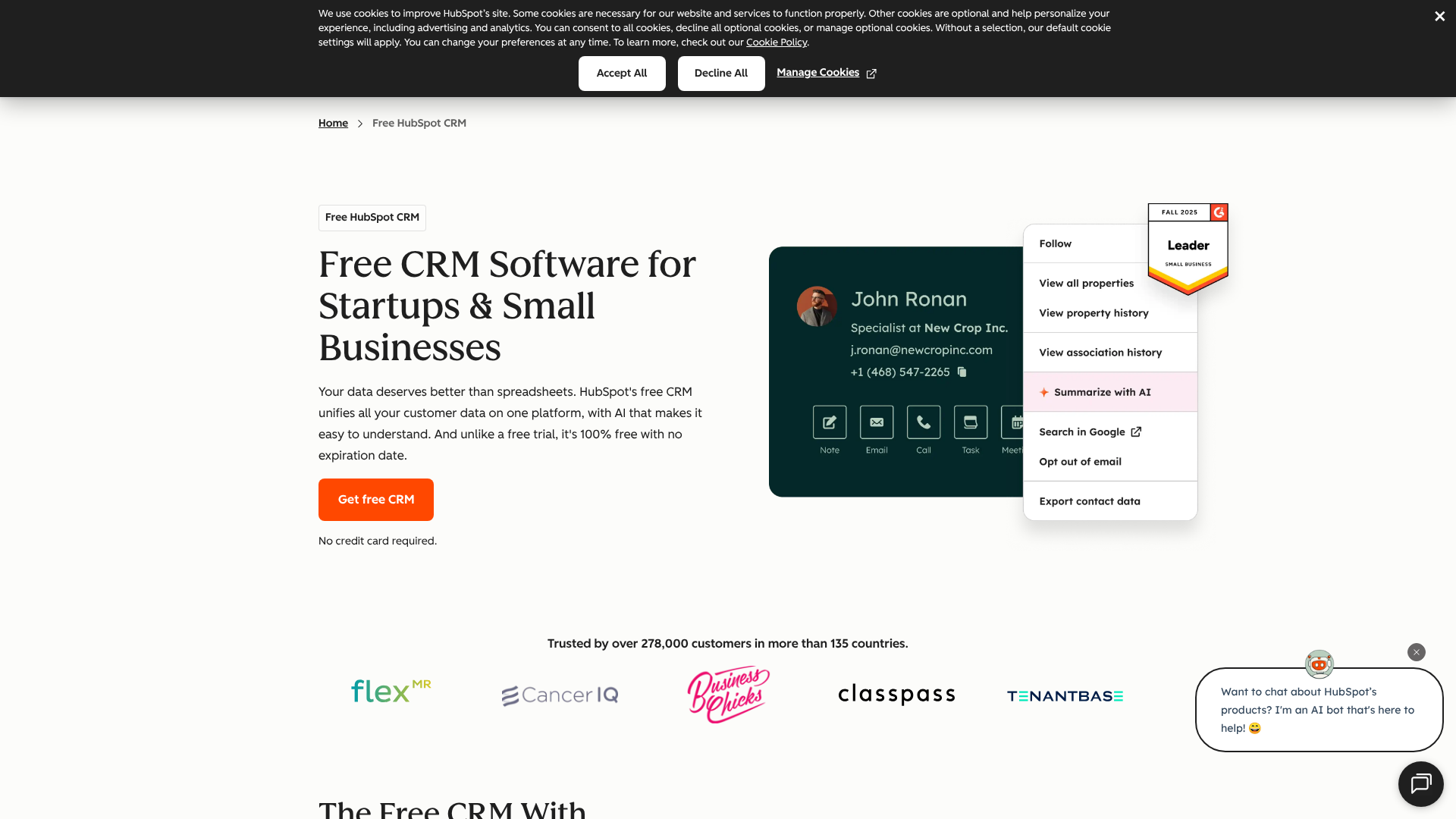
HubSpot CRM is known for its user-friendly interface and powerful free tools, but its Sales Hub professional tiers include a robust set of AI features. It offers predictive lead scoring, AI-powered sales forecasting, and conversation intelligence that automatically analyzes calls made through the platform. Its AI assistants can help reps write emails and summarize long contact threads.
Pros:
- All-in-one platform that tightly integrates marketing, sales, and service.
- Strong AI features are built directly into the CRM workflow.
- Excellent for businesses of all sizes, with a free version to get started.
Cons:
- The most advanced AI features are locked behind higher-priced tiers.
- Can become expensive as your team and contact list grow.
Best for: Businesses looking for a unified platform to manage the entire customer lifecycle.
2. Zoho CRM
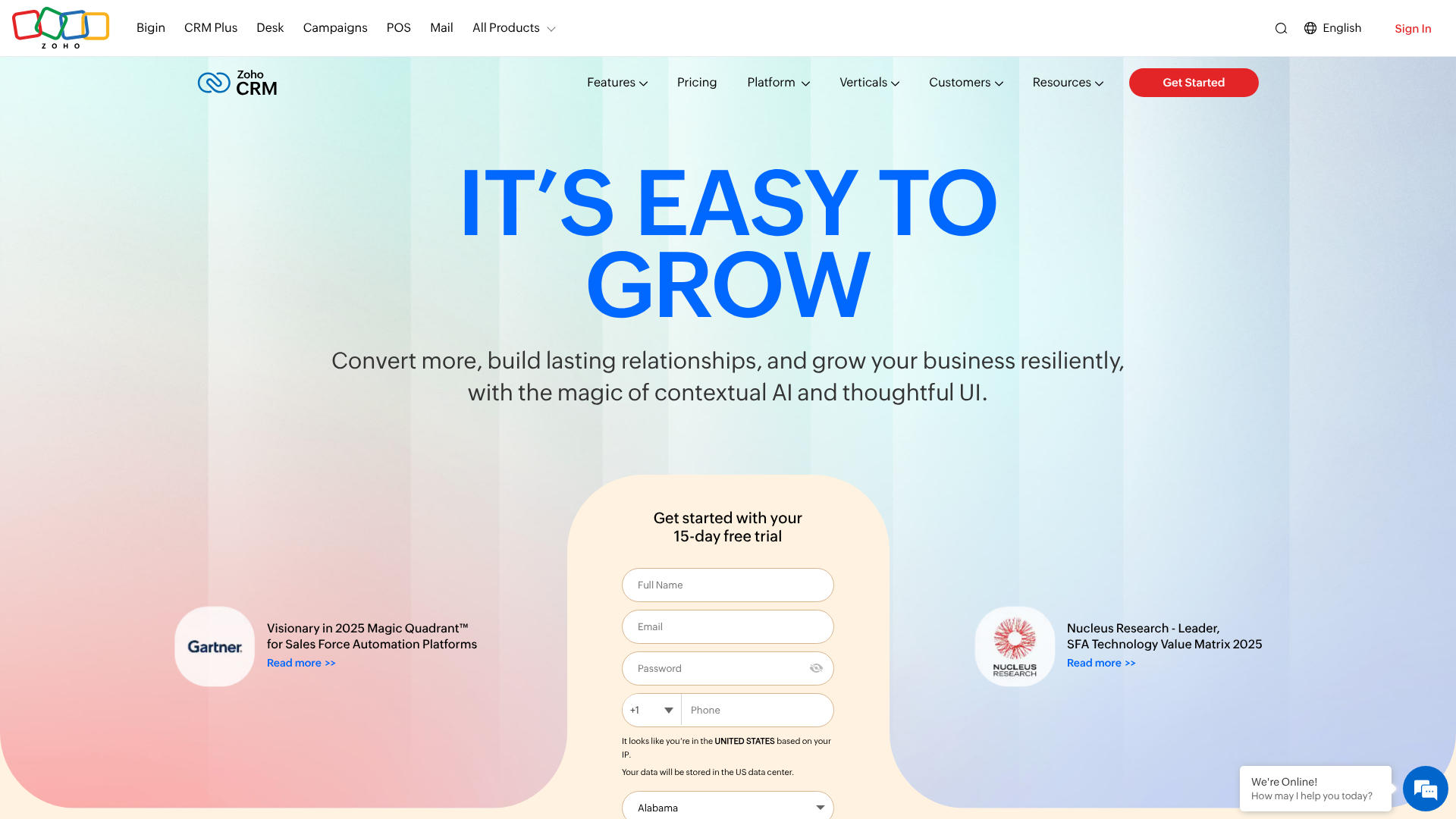
Zoho CRM features a powerful AI assistant named Zia. Zia acts as a conversational AI that can fetch data, take notes, and provide intelligent recommendations. It powers Zoho's predictive sales capabilities, including lead and deal prediction, and can identify anomalies in your sales process. Zia also suggests the best time to contact a lead based on their past engagement patterns.
Pros:
- Zia provides comprehensive AI assistance across the platform.
- Highly customizable and integrates with the wide Zoho ecosystem of business apps.
- Generally more affordable than some of its direct competitors.
Cons:
- The sheer number of features and customization options can be overwhelming for new users.
- The user interface can feel less modern than some alternatives.
Best for: Small to mid-market businesses that need a powerful, customizable CRM with a built-in AI assistant.
3. Pipedrive
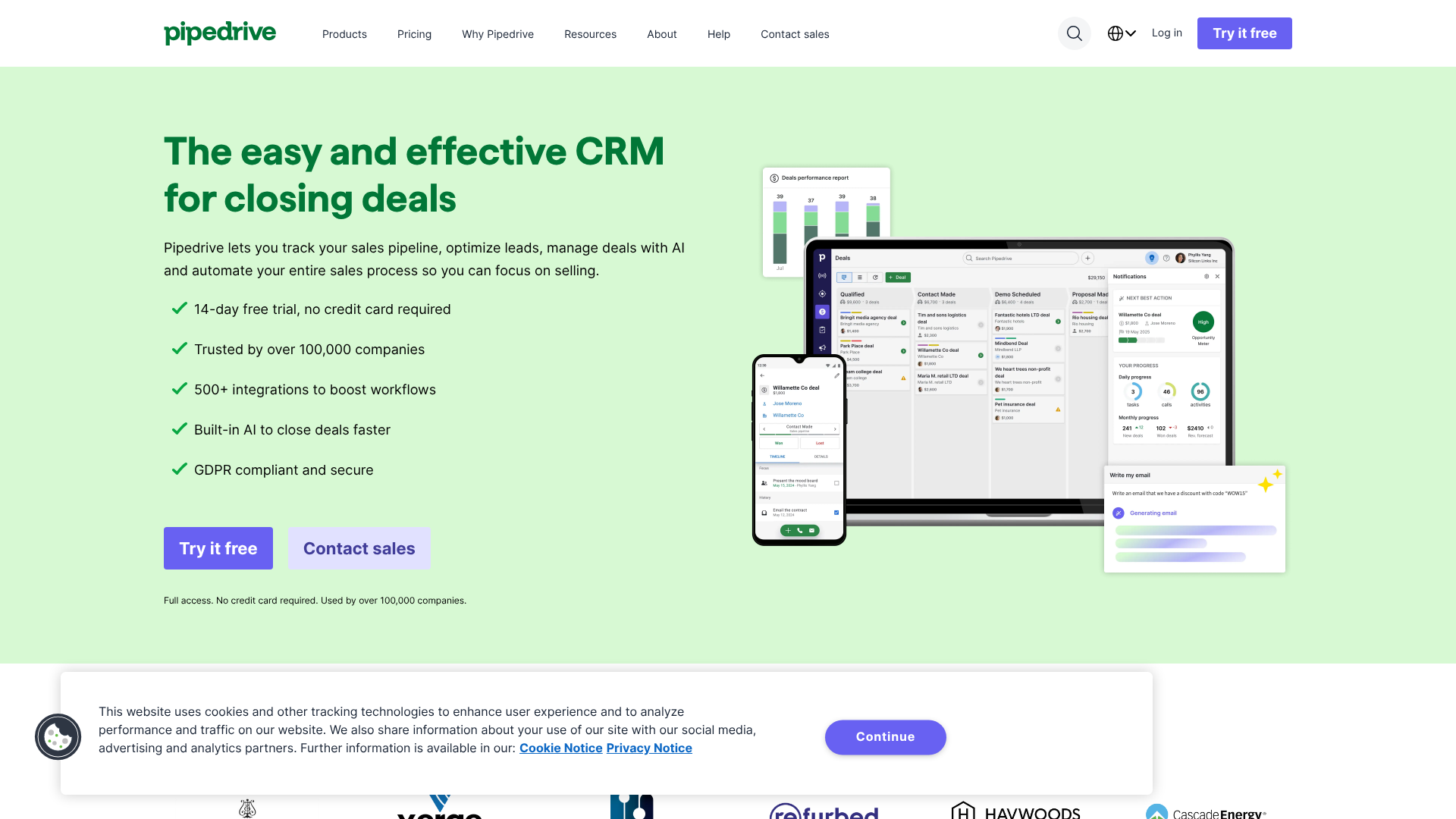
Pipedrive is a CRM designed by salespeople, for salespeople, with a strong focus on its visual sales pipeline. Its AI Sales Assistant analyzes your past performance to suggest which deals to focus on and identifies opportunities that might be slipping through the cracks. It also provides performance tips and automates tasks to keep reps focused on activities that drive revenue.
Pros:
- Extremely intuitive and easy-to-use visual interface.
- AI features are focused on actionable recommendations and workflow automation.
- Strong mobile apps for sales reps on the go.
Cons:
- AI capabilities are not as deep as those in HubSpot or Zoho.
- Less suitable for complex sales organizations that require deep customization.
Best for: Sales teams that prioritize ease of use and a visual approach to pipeline management.
4. Close CRM
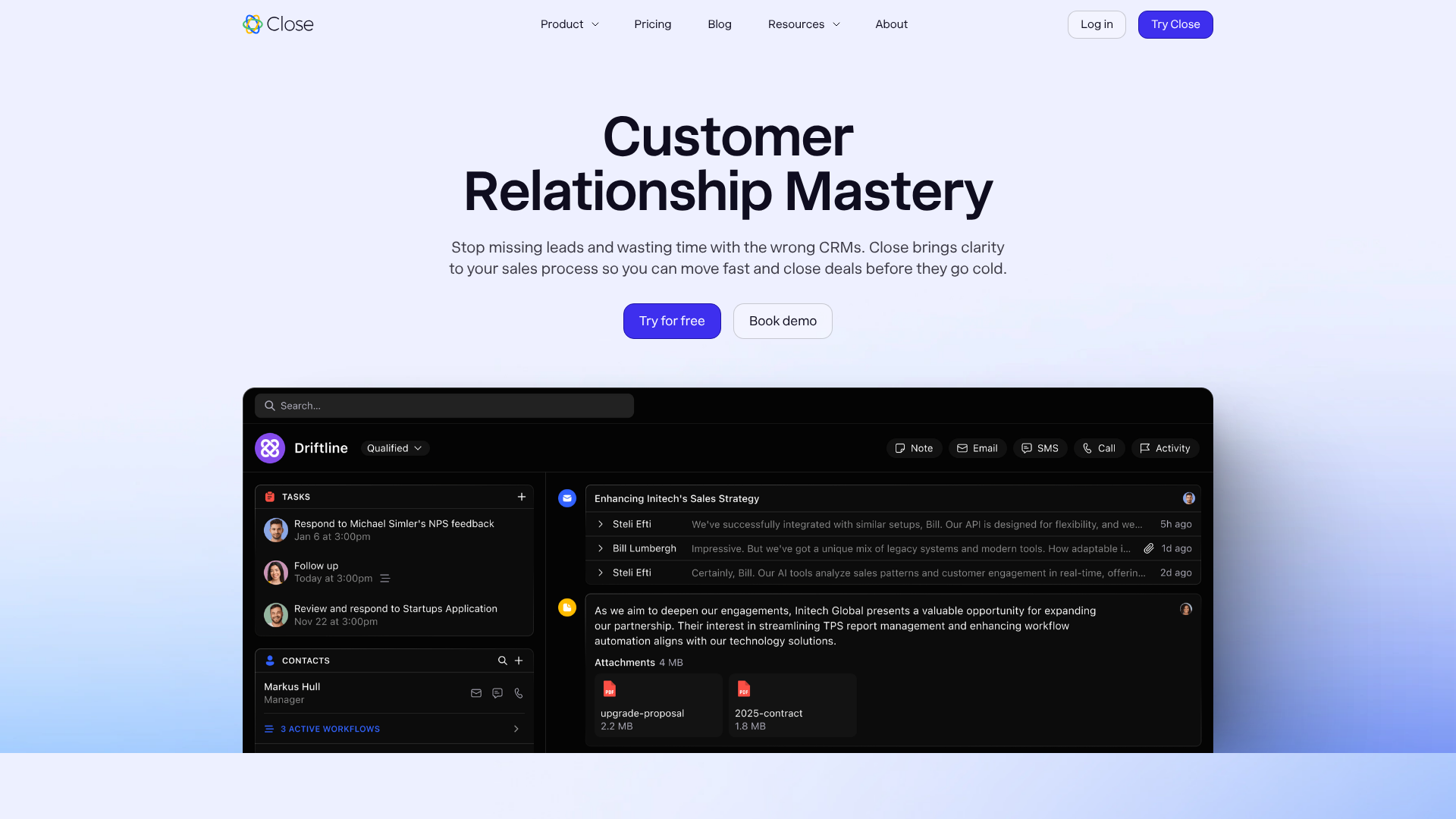
Close CRM is built for high-velocity inside sales teams. Its core strength is integrating communication channels—calling, email, and SMS—directly into the CRM. Its AI features are designed to enhance this workflow, with an AI-powered call summarizer that automatically creates notes and an email reply generator that helps reps respond faster. This focus on communication efficiency makes it a powerful tool for teams making hundreds of calls and sending thousands of emails.
Pros:
- All-in-one communication and sales platform streamlines outreach.
- AI features are practical and directly support high-volume sales activities.
- Simple, no-nonsense interface that's easy for reps to learn.
Cons:
- Lacks some of the advanced marketing automation and reporting features of larger CRMs.
- Primarily focused on inside sales teams, so it may not be the best fit for field sales.
Best for: High-volume inside sales teams that live on the phone and in their email inbox.
| Feature | HubSpot CRM | Zoho CRM | Pipedrive | Close CRM |
|---|---|---|---|---|
| Core Function | All-in-one Customer Platform | Customizable Business CRM | Visual Sales Pipeline | High-Velocity Sales CRM |
| Key AI Feature | Predictive Lead Scoring | Zia AI Assistant | AI Sales Assistant | AI Call Summarizer |
| Best For | Unified Sales & Marketing | Customizable Workflows | Simplicity & Visuals | High-Volume Outreach |
| Try hubspot crm | Try zoho crm | Try pipedrive | Try close crm |
Category: Conversation Intelligence
These tools analyze sales conversations to provide coaching and insights.
5. Gong.io
Gong is a market leader in this category. It records, transcribes, and analyzes every customer interaction across phone, email, and web conferencing. Its AI identifies deal risks, highlights successful talk tracks, and provides managers with the data they need to coach their teams effectively. It helps standardize what your top performers do and scales those behaviors across the entire team.
6. Chorus.ai (by ZoomInfo)
Similar to Gong, Chorus.ai provides deep insights into sales conversations. It helps you understand what's working in your sales process and what's not. Chorus can pinpoint key moments in calls, track competitor mentions, and ensure that reps are following up on next steps. Its integration with ZoomInfo's B2B data provides additional context on the people and companies your team is talking to.
Category: Sales Engagement & Prospecting
These platforms help you find leads and orchestrate personalized outreach at scale.
7. Outreach.io
Outreach is a sales engagement platform that helps reps build pipeline and close deals faster. It uses AI to optimize outreach sequences, suggesting the best time to send an email or make a call. Its AI-powered insights help managers understand which sequences are performing best and identify coaching opportunities for their reps.
8. Apollo.io
Apollo is an all-in-one sales intelligence and engagement platform. It combines a massive B2B database of contacts with tools to automate outreach. Its AI helps with lead scoring, personalizing email copy, and determining the best sending times to maximize engagement. It's a powerful tool for teams that need both lead data and the means to act on it.
Category: Email & Content Assistants
These tools live inside your inbox and help you write better sales messages.
9. Lavender
Lavender is a real-time email assistant that helps sales reps write more effective emails. It analyzes your email before you send it, providing a score and suggestions for improvement based on data from millions of sales emails. It helps with tone, clarity, length, and subject lines to increase your reply rates.
10. Regie.ai
Regie.ai goes beyond email coaching and uses generative AI to create entire sales campaigns. It can build multi-touch sequences, write personalized emails, and even generate social media content. It helps teams create high-quality sales collateral quickly, ensuring a consistent and effective message across all channels.
Category: Data Enrichment
11. Clay
Clay is a powerful tool that automates the most time-consuming part of prospecting: finding and enriching lead data. It connects with dozens of data providers and uses AI to build complex, automated workflows. You can use it to find verified emails, research leads on LinkedIn, and even use AI to write hyper-personalized first lines for your cold emails, all at scale.
How to Successfully Implement AI Sales Tools in Your Team
Buying a powerful tool is only the first step. The real return on investment comes from successful adoption and integration into your team's daily workflow. A haphazard rollout can lead to confusion, low usage, and wasted resources. A strategic approach is essential.
Start with a Specific Problem
Don't adopt AI for the sake of AI. Identify a clear, specific business problem you want to solve. Are your reps spending too much time on data entry. Is your sales forecast consistently inaccurate.
Are your cold email reply rates too low. By focusing on a single, measurable problem, you can choose a tool that directly addresses that pain point and demonstrate its value quickly.
Choose the Right Tool for Your Workflow
The best tool is one that fits seamlessly into your existing processes. If your team lives inside your CRM, look for a tool with a deep, native integration. If your reps are constantly on the phone, a conversation intelligence platform is a natural fit. Forcing your team to adopt a clunky tool that disrupts their workflow is a recipe for failure.
Secure Buy-In from Leadership and Sales Reps
Adoption must be driven from both the top down and the bottom up. Leadership needs to champion the initiative and provide the necessary resources. Sales reps need to understand how the tool will benefit them directly—by saving them time, helping them close more deals, and making them more money. Involve key sales reps in the evaluation process to make them feel like part of the decision.
Pro Tip: Frame the new tool as an assistant that handles the boring parts of the job, not as a replacement. When reps see AI as a tool that helps them hit their quota faster, they are far more likely to embrace it.
Integrate with Your Existing Tech Stack
Data silos are the enemy of an effective AI strategy. Ensure your new tool integrates smoothly with your CRM and other critical systems. The goal is to create a unified data ecosystem where information flows freely between platforms. This allows the AI to have a complete picture of the customer journey, leading to more accurate insights and recommendations.
Start Small with a Pilot Program
Instead of rolling out a new tool to the entire sales organization at once, start with a small pilot group of tech-savvy and motivated reps. This allows you to work out any kinks in the implementation, gather early feedback, and build a collection of success stories. Once the pilot group is seeing positive results, you can use their experience to drive adoption across the rest of the team.
Real-World Wins: Success Stories with AI-Driven Sales Solutions

Theory and features are one thing, but the true test of AI sales tools is their impact on real-world business outcomes. Companies across various industries are using these technologies to achieve measurable improvements in their sales performance. Here are a few examples of how AI can drive success.
Case Study 1: SaaS Company Boosts Lead Conversion by 25%
A mid-sized SaaS company was struggling with a high volume of inbound leads. Their sales team was overwhelmed, and high-potential leads were slipping through the cracks. By implementing an AI-powered CRM with predictive lead scoring, they were able to automatically prioritize leads based on their likelihood to close. Reps could immediately focus on the top-scoring leads, resulting in a 25% increase in their lead-to-customer conversion rate within six months.
Case Study 2: Manufacturing Firm Improves Forecast Accuracy
A large manufacturing firm had a history of inaccurate sales forecasts, which caused problems with inventory and resource planning. They adopted an AI forecasting tool that analyzed their historical deal data, pipeline health, and rep activity. The AI platform provided a more objective and data-driven forecast, improving accuracy from 70% to over 90%. This allowed the company to make much more reliable business decisions.
Case Study 3: Small Business Frees Up 10 Hours Per Rep Weekly
A small business with a lean sales team found that their reps were spending nearly a third of their time on administrative tasks instead of selling. They implemented a sales engagement platform with AI automation features. The tool automated email sequencing, activity logging, and CRM updates. This saved each rep an average of 10 hours per week, which they were able to reinvest in prospecting and customer conversations, leading to a 40% increase in pipeline generation.
Navigating the Hurdles: Common Challenges in Adopting AI in Sales
While the benefits of AI in sales are significant, the path to successful adoption is not without its challenges. Being aware of these potential hurdles can help you plan for them and increase your chances of a smooth implementation.
Data Quality and Privacy Concerns
AI is only as good as the data it's trained on. If your CRM is filled with incomplete, outdated, or inaccurate data, the AI's predictions and recommendations will be unreliable. A data cleanup project is often a necessary prerequisite for implementing an AI tool. Additionally, handling customer data with AI raises important privacy and compliance concerns (like GDPR and CCPA) that must be addressed carefully.
Resistance to Change and Lack of Trust
Sales can be a very traditional field, and some veteran reps may be skeptical of new technology. They might fear that AI will replace them or that it won't understand the nuances of their customer relationships. Building trust is crucial. This involves being transparent about how the AI works, demonstrating its value with clear success stories, and emphasizing its role as a supportive tool, not a replacement.
The Cost and Complexity of Implementation
Advanced AI sales tools can be a significant financial investment. Beyond the subscription fees, there are costs associated with implementation, integration, and training. The complexity of setting up these tools and connecting them to your existing systems should not be underestimated. It often requires dedicated IT resources and a clear project plan.
The Risk of Over-Automation and Losing the Human Touch
There's a fine line between efficiency and impersonality. Over-relying on automation can make your sales process feel robotic and alienate customers. The goal is to use AI to handle the tasks that don't require a human touch, so reps have more time for meaningful, personalized interactions. It's critical to train your team on when to use automation and when to apply their personal expertise and empathy.
The Future of Selling: What's Next for AI in Sales?
The evolution of AI in sales is happening at a rapid pace. The tools available today are already transforming the industry, but the advancements on the horizon promise even more significant changes. Staying aware of these future trends can help you build a sales organization that's prepared for what's next.
Hyper-Automation and Autonomous Sales Agents
We are moving beyond simple task automation towards hyper-automation, where AI can manage complex, multi-step workflows independently. In the near future, we may see autonomous AI agents capable of handling the entire top-of-funnel process, from identifying ideal customers and finding their contact information to conducting initial outreach and booking a meeting with a human sales rep.
AI-Powered Sales Coaching in Real-Time
While conversation intelligence already provides post-call analysis, the next frontier is real-time coaching. Imagine an AI assistant listening to a live sales call and providing the rep with on-screen prompts. It could suggest a relevant case study to mention, provide an answer to a tough objection, or remind the rep to ask about budget, all in the moment.
Deeper Integration Across the Entire Revenue Funnel
AI will continue to break down the silos between marketing, sales, and customer service. A single, unified AI engine will manage the entire customer journey, providing a seamless experience for the customer and a complete, 360-degree view for the business. This will enable unprecedented levels of personalization and proactive customer engagement.
Ethical AI and Transparency
As AI becomes more powerful, the focus on ethical use and transparency will intensify. Companies will need to be clear about how they are using AI to interact with customers and how they are protecting their data. AI models that are explainable—meaning they can show how they arrived at a particular recommendation—will become the standard, building trust with both users and customers.
Traditional vs. AI-Driven Sales: A Head-to-Head Comparison
The shift from traditional sales methods to an AI-driven approach represents a fundamental change in strategy, tactics, and mindset. The following table highlights the key differences between these two worlds.
| Aspect | Traditional Sales | AI-Driven Sales |
|---|---|---|
| Prospecting | Manual research, purchased lists, cold calls | Automated lead discovery, intent data analysis, ideal customer profile matching |
| Lead Prioritization | Based on gut feeling, basic demographics (e.g., company size) | Predictive scoring based on thousands of behavioral and firmographic data points |
| Outreach | Generic templates, manual sending | Hyper-personalized messages generated by AI and delivered at scale through automated sequences |
| Coaching | Manager ride-alongs, weekly pipeline reviews, subjective feedback | Real-time feedback on every call and email, data-backed performance insights |
| Forecasting | Manual pipeline review, optimistic rep estimates | Data-driven predictions with confidence scores, identification of at-risk deals |
| Daily Workflow | Dominated by administrative tasks and data entry | Focused on high-value activities like customer conversations and strategic planning |
Empowering Your Team: Best Practices for Training Reps on AI Tools
Effective training is the bridge between purchasing a powerful AI tool and seeing a return on that investment. A well-designed training program can accelerate adoption, build confidence, and ensure your team uses the new technology to its full potential.
Focus on the "Why," Not Just the "How"
Start by explaining the strategic reasons for adopting the new tool. Show your reps the data on how much time they'll save or how it can help them identify better leads. When they understand the direct benefit to their own success and compensation, they will be much more motivated to learn the technical "how-to" aspects of the software.
Provide Hands-On, Role-Specific Training
Generic, one-size-fits-all training sessions are rarely effective. Tailor the training to different roles within your sales team. A Sales Development Representative (SDR) needs to learn how to use the AI for prospecting and outreach, while an Account Executive needs to focus on how it helps with deal management and forecasting. Use real-world scenarios and let them practice in a sandbox environment.
Create AI Champions Within the Team
Identify a few enthusiastic, tech-savvy reps to become early experts on the new tool. These "AI Champions" can provide peer-to-peer support, share best practices, and help build momentum for adoption across the team. Their success stories will be more relatable and persuasive to their colleagues than directives from management.
Pro Tip: Reward your AI Champions for their efforts. This could be a small bonus, public recognition, or giving them a voice in future technology decisions. This incentivizes them to help their peers and fosters a culture of shared learning.
Establish Clear Guidelines and Best Practices
Provide your team with a clear playbook for how to use the AI tool. This should include guidelines on when to use automation, how to interpret AI-driven insights, and best practices for maintaining data hygiene. This prevents misuse of the tool and ensures that everyone is using it in a consistent and effective way that aligns with your company's sales methodology.
Continuously Gather Feedback and Iterate
Training isn't a one-time event. Schedule regular check-ins and refresher sessions. Create a channel for reps to ask questions and provide feedback on the tool. This allows you to address issues as they arise, share new tips and tricks, and continuously optimize your use of the technology over time.
Frequently Asked Questions About AI Sales Tools
Which AI tool is best for sales?
There is no single "best" AI tool for all sales teams. The best tool depends on your specific needs. If you need a central hub for all customer data, an AI-powered CRM like HubSpot CRM is ideal. If your biggest challenge is improving call quality, a conversation intelligence tool like Gong is the answer.
Start by identifying your biggest bottleneck and choose a tool that specializes in solving that problem.
How can AI be used in sales?
AI can be used across the entire sales cycle. Key applications include automating administrative tasks like data entry, using predictive analytics for lead scoring and forecasting, analyzing sales calls for coaching insights, generating personalized email and ad copy, and identifying new sales opportunities based on customer behavior and intent data.
Can AI replace salesmen?
No, AI is not expected to replace sales professionals. Instead, it augments their abilities. AI excels at data analysis, pattern recognition, and automation—tasks that are time-consuming and difficult for humans. This frees up salespeople to focus on uniquely human skills like building relationships, strategic thinking, complex problem-solving, and empathy, which are essential for closing complex deals.
Is Salesforce AI powered?
Yes, Salesforce is heavily invested in AI. Its AI platform is called Einstein, which is integrated across its Sales Cloud, Service Cloud, and Marketing Cloud products. Salesforce Einstein provides features like predictive lead scoring, opportunity insights, and automated activity capture to make sales teams more productive and effective within the Salesforce ecosystem.
What is the #1 CRM in the world?
By market share, Salesforce is widely considered the #1 CRM in the world, particularly for enterprise-level companies. However, for small and medium-sized businesses, platforms like HubSpot are extremely popular due to their ease of use and powerful free offerings. The "best" CRM is the one that best fits a company's size, budget, and specific needs.
Final Thoughts: Integrating AI to Build a Smarter Sales Engine
The adoption of AI is no longer a futuristic concept; it's a present-day necessity for any sales organization that wants to remain competitive. By automating manual work and delivering powerful data-driven insights, AI-powered sales tools empower representatives to operate at a level of efficiency and effectiveness that was previously unimaginable. They transform the sales role from a numbers game into a strategic, intelligence-led profession.
Remember, the goal is not to replace the human element of sales but to enhance it. AI handles the science of selling—the data, the patterns, the predictions—so that your team can master the art of selling—the relationships, the trust, and the creative problem-solving. By thoughtfully integrating these tools, you can build a smarter, faster, and more successful sales engine.
If you're ready to explore how an AI-powered CRM can become the foundation of your sales stack, consider checking out the free tools from HubSpot CRM or the visual pipeline management of Pipedrive. Starting with a strong, intelligent core is the first step toward transforming your sales process.

